1) The Southern Sun — Where Sugar and Spice Set Sail
Lu wei is geography made edible. Its aroma rides the wind that rose from Minnan and Teochew, crossed Luzon and Malacca, and settled among the South Seas.
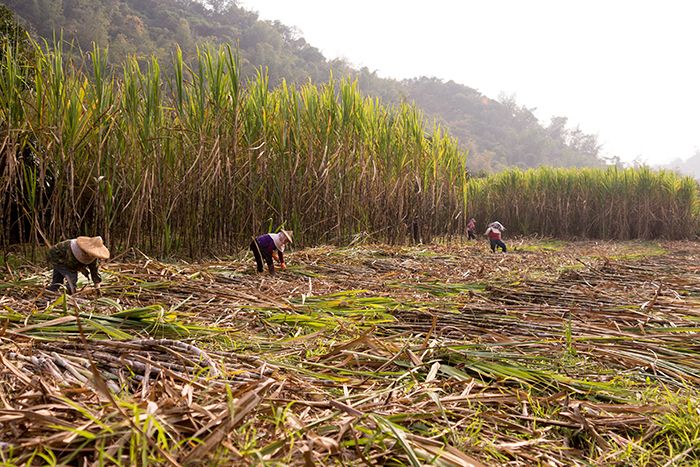
Time itself was boiled in molasses. The Lingnan Miscellany speaks of “fields of sugarcane like bamboo.” By the Ming–Qing era, Guangdong, Fujian, and Hainan were the sugar heartlands.
Spice was the ocean’s gift. The Zhu Fan Zhi notes ships from Quanzhou and Zhangzhou returning with pepper, sappanwood, cloves. Sugar met spice; red-braising and lu became a grammar of taste.
Sugar gave depth to time; spice gave shape to the air. Southern braised pork is where sunlight meets sea breeze.
2) Cane Sugar & Palm Sugar — Tropics of Sweetness
Sweetness in the South was never singular. Minnan and Taiwanese black sugar carried grassy caramel; the Philippines’ Pata Tim, Malaysia’s Humba, and Indonesia’s Semur inherited this cane-sugar braise.
Near the equator, cane met palm. Palm sap was boiled into a dark amber sugar—thicker, richer, faintly fruity. The stew gained tropical layers: salt met sweet, sweet unfolded into fragrance. Palm sugar softened the glaze’s shine—like sunlight trembling across a calm sea.
3) The Route of Aroma — Spice Riding the Southern Wind
Star anise, cassia, and bay were daily companions in the South but luxuries in the North. The History of the Song records pepper and sappanwood arriving through Guangzhou. Li Shizhen’s Compendium of Materia Medica (1596) finally lists anise as food and medicine alike. Spice’s journey marked the climate divide: humid South needed aromatic preservation; the North, dry and cold, relied on salt and soy.
In the South, spice was a protagonist; in the North, a whisper.
4) Northern Solidity — Salt, Soy, and Malt Sugar
Where cane fields ended, northerners made sugar from grain. The Qimin Yaoshu describes malt syrup “sweet and moist, boiled from sprouted barley.” This malt sugar traded aroma for depth. Northern braises—pork, chicken, fish—took color and shine from it.
Southern sugar is the sun of plants; northern sugar the time of grains.
5) Japan — The Soft Light of Sugar
Japan’s sweet history is the biography of sugar. The Engishiki (10th c.) lists the imperial making of seasoning and soy; sugar became common only in the Edo era as “Tang sugar” from Ryukyu and Fujian.
Sugar met soy to create teriyaki—literally, “glossy grill.” Fujian merchants in Nagasaki introduced the red-braise that evolved into Buta Kakuni: sugar, soy, sake, ginger—slow-simmered, a Japanese cousin of Pata Tim. Yanagi Sōetsu wrote, “The glow of teriyaki is the symbol of a sugar culture.”
6) Korea — Fruit Sweetness and the Persistence of Soy
The peninsula grew no cane; sugar was royal tribute. Thus the art of “fruit for sugar” emerged—pear juice, apple purée, malt syrup. The Gyuhap Chongseo (19th c.) notes, “Simmer meat in pear juice to replace sugar.” Jangjorim and Galbijjim balance soy, garlic, fruit sweetness, and malt. Korean sweetness is clear and crisp—like a breeze of fruit that gives salt a human warmth.
7) A Map of Taste
Region
Sugar Source
Spice Profile
Flavor Character
South (China–SE Asia)
Cane, Palm
Anise, Cassia, Bay
Warm, Rounded, Fragrant
Central China
Rock, Malt
Sichuan pepper, Alliums
Deep Savory
Japan
Tang sugar, Mirin
Ginger, Sanshō
Glossy Sweetness
Korea
Pear, Malt
Garlic, Chili
Bright Fruit Sweet
📜 References
Qimin Yaoshu (6th c.), “On Making Malt Sugar.”
Lingnan Miscellany (Ming): accounts of cane cultivation.
History of the Song Dynasty, Book of Economy & Trade: spice routes via Guangzhou.
Li Shizhen, Compendium of Materia Medica (1596).
Engishiki (10th c., Japan).
Gyuhap Chongseo (19th c., Korea).
Yanagi Sōetsu, The Unknown Craftsman, Iwanami Shoten, 1948.